How to evaluate ROI of Amazon seller coaching programs?
The $15K Question: Why Most Amazon Sellers Waste Money on Coaching
You’re doing seven figures. You’ve mastered the basics. Yet you’re considering a coaching program that costs more than your monthly ad spend. The real question: will this program actually move your profit needle? Most won’t.
Here’s the problem. Most programs showcase revenue growth–easy to game with higher ad spend–while completely ignoring margin compression. You could “grow” from $2M to $3M and still be worse off if your net proceeds percentage dropped from 18% to 12%.
The Hidden Cost of ‘Hope-Selling’ Programs
A $15K program teaching “mindset” and “brand building” without touching ACOS optimization, inventory turns, or supplier negotiation? That’s entertainment. The real cost isn’t the tuition–it’s the six months you spend implementing strategies that don’t address your actual bottleneck.
The Benchmark: A $15K program must generate $60K+ in annual profit gains to justify the spend. That’s 4:1 after accounting for your time investment. Anything less means you’re subsidizing someone else’s business model.
Why Margin Gains Matter More Than Credentials
A coach who scaled to $10M five years ago might be teaching outdated attribution models. What you need: someone who can walk through your P&L and identify the three highest-impact profit drivers in your specific category. Can they show case studies with disclosed EBITDA improvements? Not vanity metrics like “2X revenue growth”–actual net proceeds gains.
Build Your Personal ROI Model: The Three-Step Profit Framework
Stop using gut feel or testimonials to evaluate programs. Build a quantitative model using your actual numbers. This takes 30 minutes and prevents expensive mistakes.
Step 1: Identify Your Margin Pain Points
Pull your last six months of P&L data. Calculate your current ACOS, TACoS, inventory turnover rate, and landed cost as a percentage of revenue. Rank these by dollar impact.
If you’re spending $50K monthly on PPC at 32% ACOS, that’s your biggest target. If you’re sitting on $200K in slow-moving inventory, that’s cash you can’t deploy elsewhere. Be brutally specific about where profit is leaking.
Step 2: Quantify Conservative Gains Using Your Actual Metrics
Use conservative estimates. If your ACOS is 32%, model a reduction to 27%–not 15%. If your inventory turns three times annually, model an increase to four turns–not eight.
Take your monthly revenue and apply these improvements. A five-point ACOS reduction on $200K monthly revenue at 32% ACOS saves you $31,250 annually. That’s your baseline ROI target before considering program cost.
Step 3: Calculate the 3:1 Return Target and Payback Period
Apply this formula: (Projected Annual Profit Gains – Program Cost – Time Investment Value) ÷ Program Cost. Your result should be 3:1 or higher within six months.
If the program costs $15K and requires 10 hours monthly (valued at $200/hour, or $12K annually), you need $57K in profit gains to hit 3:1. If your conservative model from Step 2 doesn’t clear this hurdle, walk away.
Audit the Curriculum: Does This Program Actually Target YOUR Bottleneck?
Curriculum audits separate programs that drive profit from those that sell hope. Request the full syllabus before any sales call. Map every module against your Step 1 pain points.
Request the Full Syllabus and Map It to Your Specific Gaps
If your bottleneck is attribution and the program offers one generic DSP module, that’s a mismatch. If you’re bleeding margin on supplier costs and the curriculum focuses on listing optimization, you’ll waste months.
Ask: “Which specific modules address reducing ACOS from X% to Y% in my category?” Vague answers are disqualifying.
Red Flags: Generic Modules That Don’t Touch Margin or Scale
Beware programs heavy on “Amazon basics,” product research for beginners, or motivational content. You’re past that stage.
Red flags include:
- No mention of DSP strategy
- Zero content on inventory planning models
- Nothing about multi-channel attribution
- Generic “build your brand” modules without CAC payback analysis
These programs target six-figure sellers trying to hit seven figures, not established operators optimizing eight-figure exits.
The Weekly Accountability Test: Private Sessions with Real P&L Review
Ask whether the program includes weekly private sessions where a mentor reviews your actual P&L and holds you accountable to margin targets. Group calls where you listen to others’ problems don’t count.
You need someone analyzing your numbers, challenging your assumptions, and tracking week-over-week progress on the metrics you identified in Step 1. Programs without this structure lack the rigor to justify premium pricing.
The Titan Network Advantage: Why Community and Systems Beat Solo Coaching
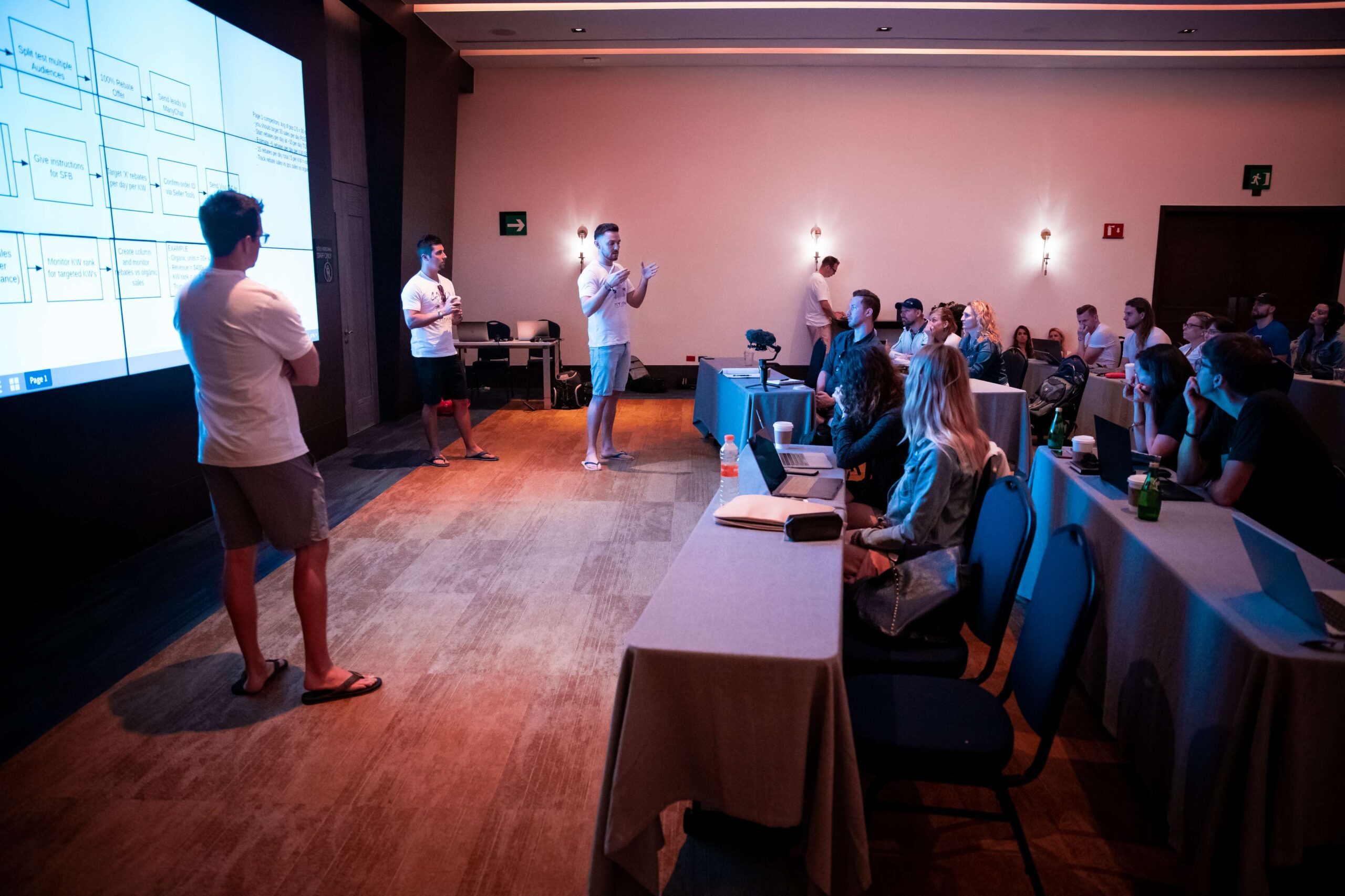
One-on-one coaching has a ceiling. You get one perspective, one playbook, one set of experiences. Titan Network flips this model by combining structured systems with peer accountability from other seven- and eight-figure sellers who’ve solved the problems you’re facing right now.
Peer Accountability Beats One-on-One Sessions Alone
When you’re stuck on a supplier negotiation, you need input from someone who renegotiated terms with a Chinese factory last month. When your DSP campaigns aren’t scaling, you need a seller in your category who solved attribution.
Weekly mentoring huddles, daily WorkParties™, and mastermind events give you access to collective intelligence that no single coach can match. This isn’t a Facebook group with noise. Every member is a verified seller doing six figures minimum, often much more.
Structured Frameworks and Battle-Tested SOPs You Can Implement Immediately
The TitanOS Playbook maps out proven strategies across PPC, product development, team building, and margin optimization. These aren’t theoretical frameworks–they’re systems built by sellers who’ve collectively driven billions in private label sales.
You get Titan Tools™ custom-built to automate high-impact tasks and improve decision-making, plus exclusive partner access to top service providers. Implementation speed matters. Generic coaching makes you build systems from scratch. Titan gives you the blueprint.
Access to Founders Who’ve Built Eight-Figure Brands
Titan’s co-founders aren’t career coaches. They’re former top 1% Amazon sellers with over 10 years of operating experience. They’ve lived the margin squeeze, the inventory nightmares, the PPC wars.
Programs range from Titan Genesis™ (starting at $997 for sellers building toward seven figures) to Titan Elite™ for operators scaling to exits. Apply today for a consultation with a Titan co-founder. Limited spots are available for Q2 cohorts.
Verify Coach Credentials: The Five-Metric Scorecard
Credentials without proof are marketing. Use this scoring framework to objectively compare programs before you commit a dollar. Assign 0-2 points per metric. Programs scoring below 7/10 lack the rigor to justify your investment.
Metric 1: Current P&L Proof from Last 12 Months
Ask for redacted P&L statements showing active operations in the past year. Coaches who exited three years ago may not understand current iOS attribution challenges, DSP bid strategies, or Amazon’s latest inventory placement fees.
Active sellers spot opportunities inactive consultants miss. No recent P&L? Automatic zero points.
Metric 2: Mentor Experience at Your Revenue Tier ($1M-$10M+)
A coach who scaled from zero to $500K can’t guide you through eight-figure supply chain complexity or multi-brand portfolio management. Verify they’ve operated at or above your current revenue level.
Ask specific questions about challenges unique to your tier: managing multiple ASINs with different margin profiles, negotiating with 3PLs at volume, or structuring teams for scale. Surface-level answers reveal experience gaps.
Metric 3: Case Studies with Disclosed Profit Gains (Not Vanity Metrics)
Revenue growth case studies can hide margin destruction. Demand examples showing EBITDA improvement, ACOS reduction with maintained volume, or inventory turn acceleration.
A case study stating “helped client grow from $2M to $5M” without disclosing whether net proceeds percentage increased or decreased is worthless. Specific profit metrics or it didn’t happen.
Metric 4: Client Accountability Structure and Support Level
Weekly private P&L reviews with action item tracking earn two points. Monthly group calls with no individual accountability earn zero.
Ask how they track your progress between sessions. Do they review your Seller Central data? Do they require you to report on implementation? Programs without structured accountability become expensive motivational podcasts you stop attending by month three.
Metric 5: Depth on High-Impact Areas (DSP, ACOS, Inventory Turns)
Request detailed outlines for modules covering your Step 1 pain points. If DSP strategy is one 60-minute overview call, that’s insufficient for sellers spending five figures monthly on advertising. If inventory management is “order more before you run out,” that’s beginner advice.
Deep programs dedicate multiple sessions to single topics, with implementation support between calls. Shallow coverage across many topics beats depth on nothing.
Scoring Guide: Add your points across all five metrics. 9-10 points indicates elite-level coaching worth premium investment. 7-8 points suggests solid value if curriculum aligns with your bottlenecks. Below 7 means you’re paying for access to someone’s personal brand, not profit-driving expertise.
Simulate ROI With Your Numbers: The Pre-Commitment Playbook
Theory becomes actionable when you plug in real data. This simulation process takes your P&L numbers and models what a coaching program must deliver to justify the investment. Complete this before any sales call.
Plug Your Metrics Into a Payback Model
Download six months of P&L data. Calculate current ACOS, TACoS, inventory turnover, and net proceeds percentage. For each metric, model a conservative improvement: reduce ACOS by 3-5 points, increase inventory turns by 0.5-1.0x, improve net proceeds by 2-3 percentage points.
Multiply these improvements by your annual revenue to get dollar impact. If you’re doing $2M annually at 28% ACOS and you model a reduction to 24%, that’s $80K in annual savings. Subtract program cost and time investment value. Your remainder must exceed 3:1 of program cost within six months to meet the ROI threshold.
Identify Three Profit Drivers and Quantify Six-Month Impact
Pick the three highest-dollar opportunities from your analysis. Example: reducing PPC waste saves $30K annually, renegotiating supplier terms adds $25K to margin, improving inventory planning frees $40K in working capital.
Ask the program to map specific modules to each driver. If they can’t show which sessions address your $30K PPC opportunity with tactics you haven’t tried, they’re not equipped to deliver your required ROI. Programs that can’t connect curriculum to your specific profit drivers fail this test.
Negotiate a Trial or Money-Back Guarantee Before Full Commitment
Confident programs offer trial periods or conditional guarantees. Ask for a 30-day trial where you implement one high-impact strategy from their playbook. Measure results against your baseline. If you see movement on your target metric, commit to the full program. If not, request a refund or walk away.
Programs that refuse trials or guarantees are betting you won’t track results carefully enough to hold them accountable. That’s a signal to move on.
Beyond the Initial ROI: Track Long-Term EBITDA and Operational Efficiency
Coaching programs end. Profit improvements should compound. Set up measurement systems before day one so you can prove ROI and sustain gains after the program concludes.
KPIs to Monitor Post-Coaching: TACoS, Inventory Turns, Net Proceeds %
Track TACoS (total advertising cost of sale) to measure whether you’re growing efficiently or just buying revenue. Monitor inventory turnover to ensure you’re not tying up cash in slow movers. Calculate net proceeds percentage monthly to catch margin erosion before it becomes structural.
Add refund rate and customer acquisition cost if you’re expanding beyond Amazon. These metrics tell you whether coaching delivered sustainable systems or temporary wins that fade when support ends.
Set Baseline Metrics Before Day One
Capture current performance across all KPIs before the first coaching session. Export Seller Central data, screenshot your advertising dashboard, and document current supplier terms.
Without baselines, you can’t prove causation. You’ll end up guessing whether that ACOS improvement came from coaching or seasonal demand shifts. Baseline documentation also forces accountability on both sides. The coach knows you’re measuring, and you know exactly what success looks like.
Monthly Benchmarking: Are You Tracking Gains Against Industry Norms?
Compare your improvements to category benchmarks. If you reduced ACOS by two points but the category average dropped three points due to lower CPCs, you actually lost ground.
Join seller communities where operators share anonymized performance data. Titan Network members access collective intelligence from hundreds of verified sellers, providing real-time benchmarks across categories. Monthly check-ins against these norms reveal whether you’re outpacing the market or just keeping up.
Making the Investment Decision: Your Final Evaluation Checklist
You’ve built your ROI model. You’ve scored the program. Now comes the commitment decision. Use this final framework to reduce doubt and ensure you’re investing in profit growth, not hope.
Compare Multiple Programs Using Your Scorecard
Never evaluate a single option in isolation. Score at least three programs using the five-metric framework. Document curriculum depth, accountability structure, and mentor credentials for each.
Create a simple spreadsheet: program name, total score, projected ROI from your Step 2 model, program cost, and payback period. The winner should score 7+ points with the shortest payback period at your conservative gain estimates. If no program clears these bars, delay the investment and focus on implementing free optimization tactics first.
Test Responsiveness Before You Pay
Send detailed questions about your specific bottlenecks during the sales process. How fast do they respond? Do they give generic answers or cite relevant case studies?
Ask them to walk through how they’d approach your biggest pain point in the first 30 days. Coaches who can’t articulate a specific game plan before you’ve paid won’t magically develop one after. Slow, vague responses during courtship predict poor support during delivery.
Verify the Refund Policy and Trial Terms
Read the fine print on money-back guarantees. Some require you to complete arbitrary tasks (“attend 80% of calls and implement 100% of recommendations”) that make refunds nearly impossible to claim. Others offer unconditional 30-day windows.
The best programs let results speak: implement one strategy, measure the impact, then decide. If a program won’t put skin in the game alongside you, that’s information about their confidence in delivering outcomes.
Critical Red Flags That Mean Walk Away
Some signals are disqualifying regardless of how compelling the sales pitch sounds. Recognizing these saves you months of wasted time and five figures of capital.
High-Pressure Tactics and Artificial Scarcity
Programs that push “only two spots left” or “price increases tomorrow” are optimizing for sales velocity, not client outcomes. Quality coaching has natural demand constraints.
Manufactured urgency means they’re filling seats to hit revenue targets, not curating a cohort of sellers at similar stages who can provide peer value. Take the time you need to complete your ROI simulation and scorecard evaluation.
Coaches Without Current Operating Experience
The Amazon ecosystem changes quarterly. Attribution models, fee structures, and algorithm behavior from 2021 don’t apply in 2024. If a coach can’t discuss recent changes to inventory placement fees, the latest DSP bidding strategies, or current iOS attribution workarounds, they’re teaching history instead of tactics.
Ask when they last managed an active PPC campaign or negotiated supplier terms. Answers older than 12 months are disqualifying.
Testimonials Heavy on Emotion, Light on Numbers
Beware programs showcasing testimonials like “this changed my business” or “best investment ever” without disclosed profit metrics. Emotional testimonials are easy to generate and impossible to verify.
Demand case studies showing before-and-after P&L snapshots with specific improvements: ACOS reduced from X% to Y%, inventory turns increased from A to B, net proceeds improved from C% to D%. Programs that can’t produce metric-based proof are selling community and motivation, not profit systems.
Maximize ROI After You Enroll
Enrollment is the start, not the finish. How you execute determines whether you hit your 3:1 return target or join the majority who complete programs without measurable profit gains.
Implement One Strategy Per Week Minimum
Knowledge without execution is expensive entertainment. Set a rule: implement at least one tactical change per week from coaching sessions.
If you learn a new DSP targeting strategy, launch a test campaign within 72 hours. If you get a supplier negotiation framework, schedule the call that week. Track implementation in a simple spreadsheet: strategy learned, date implemented, metric impacted, result after 30 days. This documentation proves ROI and identifies which strategies deliver for your specific business.
Bring Real Data to Every Coaching Session
Generic questions get generic answers. Show up with your actual numbers: current ACOS by campaign, inventory aging report, and supplier cost breakdown.
Ask specific questions: “My branded campaign ACOS jumped from 12% to 18% last month while conversion rate held steady. What diagnostic steps should I take?” Data-driven questions force tactical responses you can implement immediately. Vague questions about “scaling” or “optimizing” waste your time and theirs.
Extract Maximum Value from Community Access
If the program includes peer groups, mine them aggressively. Post your challenges in community channels. Schedule calls with members one tier ahead of you. Share your wins and failures to build reciprocal relationships.
The collective intelligence of a strong seller community often exceeds the coach’s individual expertise. Programs like Titan Network transformative workshops for business growth structure this intentionally through daily WorkParties™ and mastermind events, creating environments where peer learning compounds your investment.
When Coaching Isn’t the Answer
Sometimes the highest ROI move is not enrolling in any program. Recognizing when you need something else prevents expensive mistakes.
You Have an Execution Problem, Not a Knowledge Gap
If you already know you should reduce ACOS, improve inventory turns, and renegotiate supplier terms but aren’t doing it, more information won’t help. You need accountability systems and implementation discipline.
Consider hiring a specialist or joining a structured accountability program like Titan’s Productivity & Accountability Program instead of general coaching. The issue isn’t what to do–it’s building systems that force you to do it.
Your Cash Flow Can’t Support the Investment Timeline
If paying for coaching means you can’t restock your best sellers or test new products, delay the investment. Coaching ROI requires capital to implement strategies. A PPC optimization framework is worthless if you don’t have a budget to test new campaigns.
Focus on cash-generating tactics first: liquidate slow inventory, negotiate better payment terms, or raise prices on high-demand ASINs. Return to coaching evaluation when you have operating capital to deploy recommendations.
You Need Specialized Technical Expertise, Not General Strategy
Some challenges require specialists, not generalist coaches. Complex catalog architecture problems need an Amazon systems expert. International expansion requires someone who lives in cross-border logistics daily. Brand Registry IP issues demand legal specialists.
General coaching programs can’t provide depth in niche technical areas. Match the solution to the problem type. Strategic coaching builds systems. Specialists solve specific technical bottlenecks.
Frequently Asked Questions
What is the ROI of Amazon seller coaching programs?
The ROI of an Amazon seller coaching program isn’t about revenue growth; it’s about measurable profit gains. Many programs sell transformation stories without real profit accountability, often leading to margin compression. A true investment should directly address your business’s specific bottlenecks and drive tangible improvements to your bottom line.
How do I calculate the ROI for an Amazon seller coaching program?
To calculate ROI, first identify your specific margin pain points from your P&L data, like ACOS or inventory turnover. Next, quantify conservative profit gains you expect from addressing these issues with the program. Finally, apply the formula: (Projected Annual Profit Gains minus Program Cost minus Time Investment Value) divided by Program Cost, aiming for 3:1 or higher within six months.
What is a good ROI for an Amazon seller coaching program?
A good ROI for an Amazon seller coaching program should be at least 3:1, or ideally 4:1, in annual profit gains after accounting for the program cost and your time investment. For example, a $15K program should generate $60K or more in annual profit improvements to be a worthwhile investment. Anything less means you’re likely subsidizing someone else’s business model.
How can I identify if an Amazon coaching program will actually help my business?
To identify a helpful program, audit its curriculum against your specific margin pain points identified in your P&L. Request the full syllabus and ensure modules directly address your bottlenecks, such as ACOS reduction or inventory planning. Beware of generic programs heavy on “basics” or motivational content that don’t touch real profit drivers.
Why should I prioritize margin gains when evaluating an Amazon seller coach?
Prioritizing margin gains ensures you’re investing in actual business health, not just vanity metrics. A coach might show “2X revenue growth,” but if your net proceeds percentage dropped, you’re losing money. What matters is if they can analyze your P&L and identify high-impact profit drivers, showing case studies with disclosed EBITDA improvements.
What kind of accountability should a high-value Amazon coaching program offer?
A high-value program should include weekly private sessions where a mentor reviews your actual P&L and holds you accountable to margin targets. This means someone analyzing your numbers, challenging assumptions, and tracking progress on your specific metrics. Peer accountability from other verified seven- and eight-figure sellers, as found in communities like Titan Network, also provides invaluable collective intelligence and support.
About the Author
Dan Ashburn is the Co-Founder at Titan Network—the world’s leading community for Amazon sellers scaling to 7 and 8 figures. A former top 1% Amazon FBA seller turned growth strategist, Dan has spent the last decade engineering data-driven campaigns that have generated hundreds of millions in marketplace sales and DTC revenue for Titan’s partners.
At Titan Network, Dan, alongside his cofounder Athena Severi and their team of top talent, architects full-funnel growth frameworks that help margin-squeezed, time-poor brands unlock quick wins, shore up profits, and expand beyond Amazon. Their playbooks fuse advanced PPC automation, creative conversion-rate optimization, and airtight supply-chain SOPs—giving sellers the step-by-step systems, expert mentorship, and peer accountability they need to dominate crowded niches while safeguarding EBITDA.
A sought-after speaker at Prosper Show, SellerCon, and White Label Expo, Dan demystifies algorithm shifts and shares ROI-focused tactics—from DSP retargeting hacks to DTC attribution modeling—empowering operators to make confident, cash-generating decisions. Titan Network has positioned itself as the world’s premier Amazon Seller Mastermind, providing high-quality tactical strategies and pinpointing growth levers that move the profit needle this quarter.